Blog
Not Too Sweet
I scraped 400 bakery reviews to see what people think a good cake should be.

I have never understood most American birthday cake.
I do not mean that I mildly prefer something else. I mean that I often cannot eat it. The combination that gets me is familiar: very sweet cake, a thick layer of frosting, and a fatty mouthfeel that can overwhelm everything else.
For a long time, I assumed I simply did not like cake. Then I went back to Asian bakeries.
The difference was immediate. The sponge was lighter. The cream was softer. Fruit mattered. Sweetness was present, but often restrained. The phrase that kept coming to mind was one I hear constantly around East Asian desserts: not too sweet.
That phrase sounds like a description. It is actually a judgment.
So I did what any perfectly normal person would do after thinking too hard about cake: I scraped 400 Google Maps reviews.
The tiny experiment
I chose four bakeries in the same Orange County, California market: 85°C Bakery Cafe, Paris Baguette, Nothing Bundt Cakes, and SusieCakes. The first two come from East Asian bakery traditions; the latter two are mainstream American cake brands.
I collected 100 unique Google Maps reviews from each brand. This was never meant to be a representative survey of Americans, Asians, or even bakery customers. It was a feasibility pilot: could ordinary customer language reveal the standards people use when deciding whether a cake is good?
The first answer was yes. The second answer was that the story was messier than I expected.
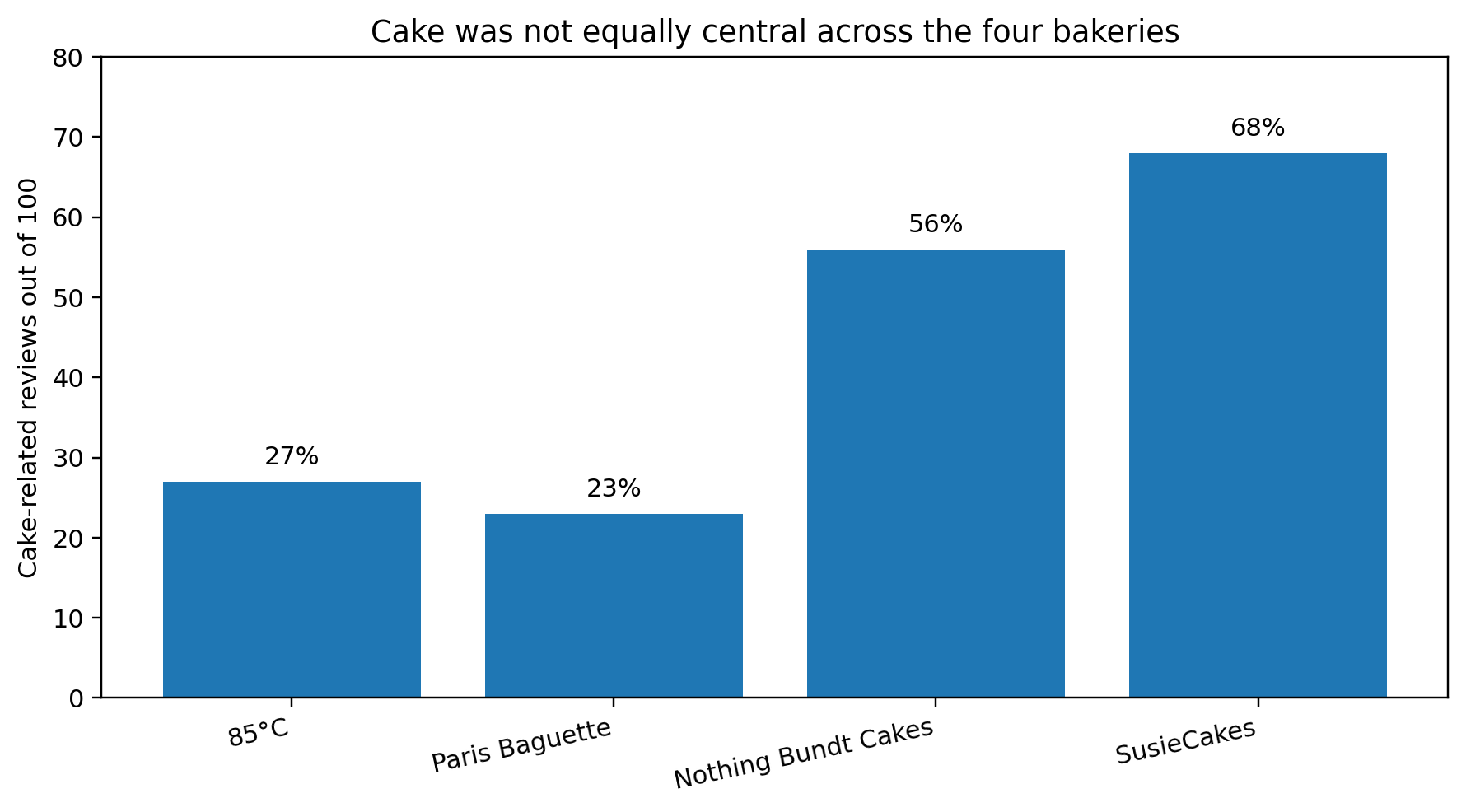
Figure 1. Share of the 100 collected reviews at each bakery that explicitly discussed cake-related products.
This immediately created a comparison problem. Only 27 of the 85°C reviews and 23 of the Paris Baguette reviews were clearly cake-related, compared with 56 at Nothing Bundt Cakes and 68 at SusieCakes. That makes sense: the first two are broad bakeries, while the latter two revolve much more heavily around cake. So raw word counts across all 400 reviews would be misleading.
The real question was not “Who likes more sugar?”
I narrowed the exploratory analysis to the 174 cake-related reviews and looked for recurring sensory dimensions: sweetness, moisture or dryness, lightness and texture, richness and frosting, and freshness. This was a simple keyword-based exploratory coding, not a validated academic codebook. For a blog post, that is enough to show the shape of the data without pretending to more precision than the pilot can support.
| Bakery | Sweetness | Moisture / dryness | Texture / lightness | Richness / frosting |
|---|---|---|---|---|
| 85°C | 29.6% | 3.7% | 25.9% | 7.4% |
| Paris Baguette | 26.1% | 8.7% | 13.0% | 0.0% |
| Nothing Bundt Cakes | 16.1% | 17.9% | 5.4% | 14.3% |
| SusieCakes | 29.4% | 19.1% | 10.3% | 20.6% |
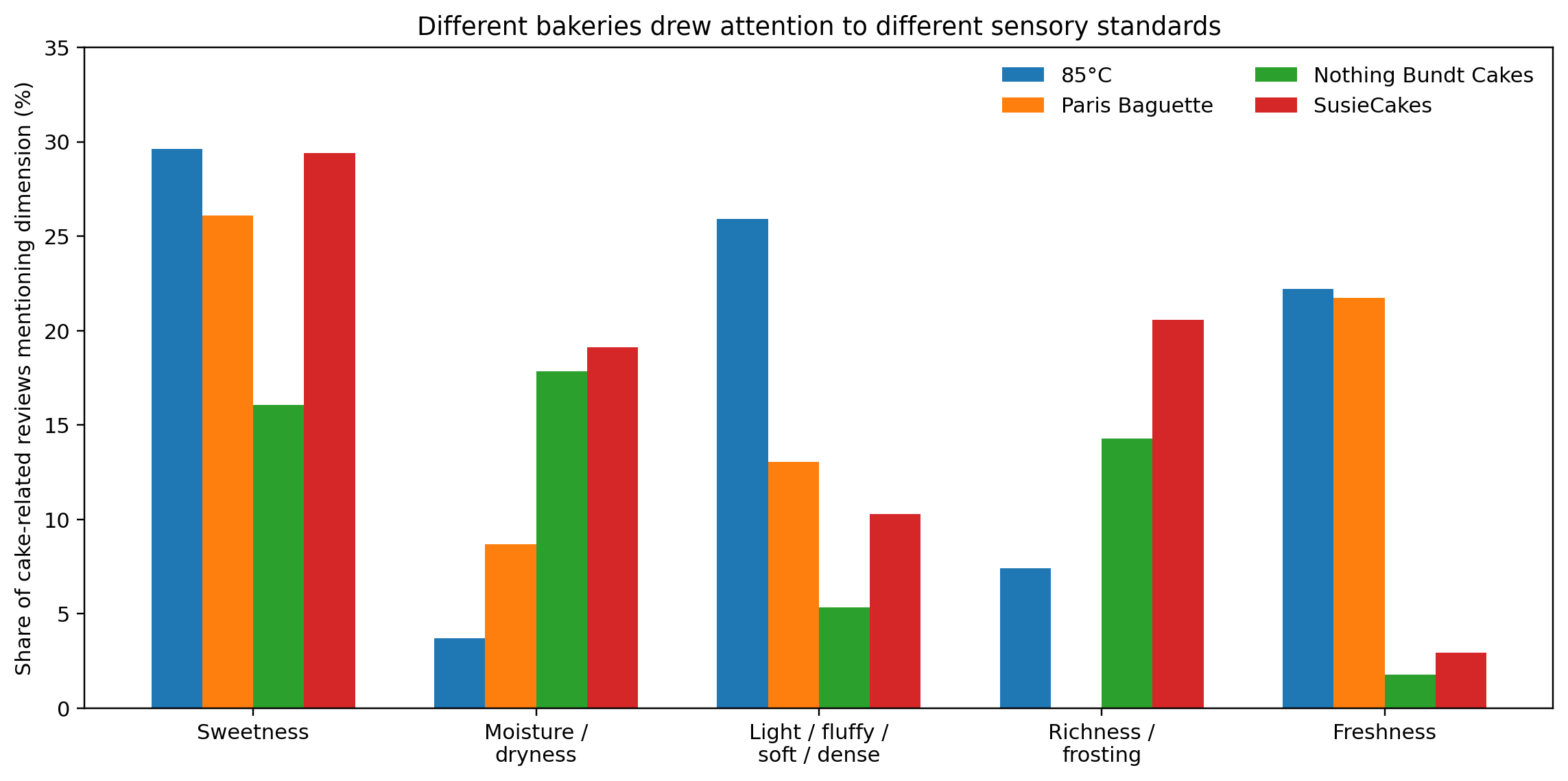
Figure 2. Exploratory sensory mentions among cake-related reviews. One review can mention more than one dimension.
The pattern was more interesting than a simple East-versus-West sweetness story. At 85°C, cake reviews often talked about sweetness together with lightness, softness, and freshness. Paris Baguette looked similar, though with fewer texture mentions. Nothing Bundt Cakes stood out for moisture. SusieCakes generated a lot of talk about sweetness, moisture, and frosting.
“Not too sweet” was real
The phrase I had noticed in real life was absolutely present in the reviews.
An 85°C reviewer praised cakes for being “beautiful and not so sweet.” Another liked desserts because they were “not overly sweet.” A Paris Baguette reviewer described cakes as “perfectly light” and flavorful without being “overwhelmingly sweet.” Another wrote that the cream “wasn’t too sweet” and the cake “wasn’t dry.”
That was the expected part.
But it was not uniquely Asian
The American cake brands immediately ruined the clean story.
A Nothing Bundt Cakes reviewer called one cake “not super sweet, just perfect.” SusieCakes reviewers repeatedly praised frosting for having the right amount of sweetness, being not overly sweet, or avoiding the “tooth-achingly sweet” problem.
And then the dataset handed me the best sentence in the entire pilot.
“My friend said they were way too sweet, but I think it was just right.”
Same cake. Same sugar. Different boundary.
That sentence gets at the distinction better than any theoretical label I could invent. “Sweet” describes an attribute. “Too sweet” makes a judgment. The word too assumes a boundary, and that boundary lives partly in the eater.
Nothing Bundt Cakes had a different religion: moisture
One of the biggest surprises was that Nothing Bundt Cakes did not mainly generate arguments about sweetness. Its cake reviews repeatedly praised moisture.
Reviewers called the cakes “so moist,” “super moist,” and “perfectly moist.” One person contrasted the cake with other bakery cakes that “tend to be dry,” then praised this one as moist and soft throughout.
For that brand, a central question seemed to be: Is the cake moist enough?
That is not the same evaluative ruler that dominated the 85°C reviews, where lightness, softness, restrained sweetness, and freshness appeared much more often.
Freshness quietly separated the bakery types
Freshness language appeared in 22.2% of 85°C cake reviews and 21.7% of Paris Baguette cake reviews, compared with only 1.8% at Nothing Bundt Cakes and 2.9% at SusieCakes.
I would not turn that into a grand claim that East Asian culture values freshness more. Brand format, product mix, display style, and store experience could easily explain part of the difference. But it supports a smaller and more useful observation: people were not merely disagreeing over how sweet cake should be. They were sometimes judging entirely different things.
So what does a “good cake” mean?
The pilot made me less interested in asking which culture likes sweeter cake.
A better question is: Which sensory dimensions become relevant when people judge a food category?
At one bakery, “good cake” may mean light, fresh, and restrained. At another, moistness may dominate. Somewhere else, the key question may be whether the frosting-to-cake ratio feels right.
The menu label stays the same. The evaluative ruler changes.
That is why “cake = cake” turns out to be a surprisingly bad assumption.
Then I killed the paper
At this point, the project looked promising. The data were easy to collect. The phenomenon was visible. The coding was feasible. There were real patterns.
And I stopped.
Once I searched the research literature more seriously, much of the conceptual territory was already occupied: food localization, cross-cultural sensory language, online reviews as sensory data, “not too sweet” discourse, and cross-national bakery-review research.
I could still have made a technically novel paper by narrowing the contribution to normative sensory boundaries. But to do that properly, I would have needed more brands, more stores, more markets, cake-only sampling, formal coding validation, and a way to separate brand effects from bakery-tradition effects.
The project was becoming methodologically larger while the remaining conceptual payoff was becoming smaller.
That is usually a bad trade.
The most useful result was the decision to stop
This is where a feasibility pilot earns its keep.
The pilot did not fail. It answered the question I needed it to answer: the phenomenon was real, but the full journal article was no longer worth the cost.
The scraper, dataset, and notes took time to build. None of that was a reason to continue. Those were sunk costs. The only question that mattered was whether the next hour, day, or week was worth spending.
I decided it was not.
So I killed the paper.
Then I realized dead research projects make excellent blog posts.
What survived
I still like the original observation.
“Not too sweet” is not merely a statement about sugar. It is a judgment about an acceptable range. The same is true of “too dry,” “perfectly moist,” “too heavy,” and “just the right amount of frosting.”
Food culture does not only teach us what to eat. It helps teach us where to place the boundary between not enough, just right, and too much.
And research does not have to become a journal article to teach us something.
Sometimes the best result of a pilot is permission to stop.
A note on the numbers
This was an exploratory blog analysis of 400 Google Maps reviews collected from one Orange County location for each of four bakery brands (100 unique reviews per brand). The sensory counts were produced with simple keyword rules within reviews that explicitly mentioned cake-related products. Reviews were not sampled to represent national populations, and reviewer identity is unknown. The figures describe this pilot dataset only; they should not be read as estimates of “American” or “Asian” taste.
The reviews were also strongly positive overall: mean ratings in the collected sample were 85°C 3.99/5, Paris Baguette 3.78/5, Nothing Bundt Cakes 4.25/5, SusieCakes 4.33/5. That is another reason I focused on how people described good cake rather than treating the review set as a contest over which bakery “won.”
Interesting observation ≠ project. Feasible ≠ worth doing. Sometimes a dead paper is a live essay.
Discussion
0 comments
Comments are reviewed before they appear. Email is optional and is never displayed publicly.
No approved comments yet.